
Difference Between 14K and 18K Gold: Purity, Price, Durability, and Value
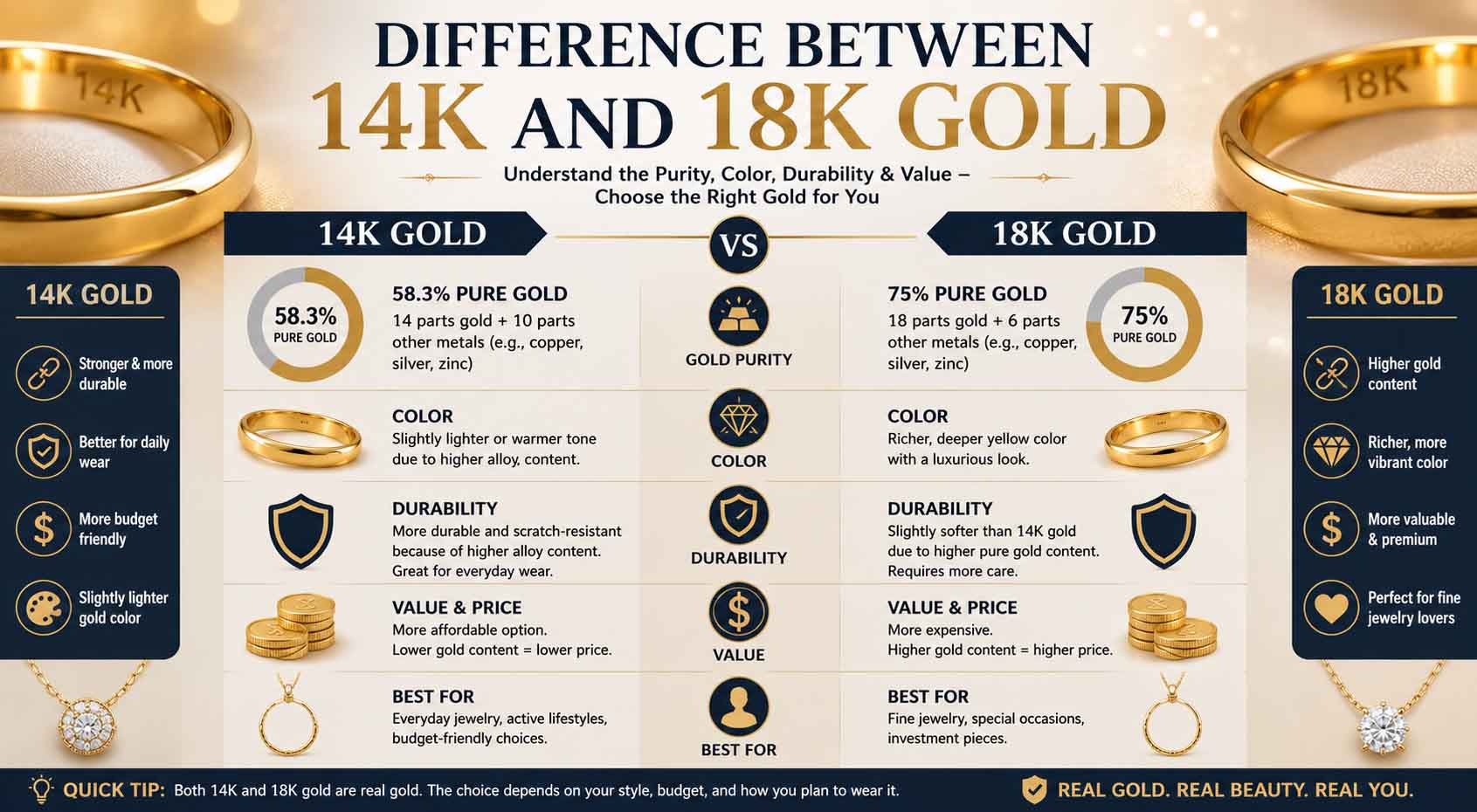
If you are buying, selling, sourcing, or pricing jewelry, understanding the difference between 14K and 18K gold is essential. The main difference is purity: 14K gold contains about 58.3% pure gold, while 18K gold contains 75% pure gold. That difference affects color, durability, price, weight, resale value, and how businesses position each product.
For consumers, the decision often comes down to durability versus higher gold content. For jewelry businesses, however, the choice also influences inventory cost, pricing strategy, customer expectations, margins, and product positioning.
Both are real gold. Still, they serve slightly different markets.
What Is the Difference Between 14K and 18K Gold?
The simplest way to understand what is the difference between 14K and 18K gold is to look at the karat system.
Pure gold is measured as 24 karats. Therefore, 24K gold represents nearly pure gold, while lower-karat gold contains a mixture of gold and other metals.
14K gold contains 14 parts gold out of 24 parts total. That works out to approximately 58.3% gold.
18K gold contains 18 parts gold out of 24. As a result, it is approximately 75% gold.
The remaining percentage usually consists of alloy metals such as silver, copper, zinc, nickel, or palladium, depending on the color and manufacturing formula.
That extra alloy content makes 14K gold generally harder and more resistant to everyday wear than 18K gold.
14K vs 18K Gold Quick Comparison
| Feature | 14K Gold | 18K Gold |
|---|---|---|
| Pure gold content | About 58.3% | 75% |
| Durability | Higher | Slightly softer |
| Gold color | More subtle | Richer and deeper |
| Price | Usually lower | Usually higher |
| Everyday wear | Very practical | Good, but needs more care |
| Luxury positioning | Mid-to-premium | Premium |
| Resale gold content | Lower | Higher |
| Common use | Engagement rings, daily jewelry | Fine jewelry, luxury pieces |
This comparison explains why both options remain popular.
One is not automatically better than the other. Instead, the better choice depends on how the jewelry will be worn, priced, and positioned.
Why 14K Gold Is Popular in Everyday Jewelry
14K gold has become a common choice for rings, bracelets, necklaces, earrings, and other pieces designed for frequent wear.
Because it contains more alloy metal, it is generally harder than 18K gold. Therefore, it can better resist scratches, dents, and deformation under normal use.
That makes it especially practical for engagement rings and wedding bands that may be worn every day.
It also costs less than 18K gold because each gram contains less pure gold.
For buyers comparing several expensive purchases, the principle behind What Are Two Questions That Smart Spenders Ask Before Making a Purchase applies well here: consider both whether the product meets your actual needs and whether the extra cost creates meaningful value.
For someone prioritizing durability and budget, 14K may offer the better balance.
Why Buyers Choose 18K Gold
18K gold contains more pure gold, which gives it a richer appearance.
Yellow 18K gold often has a deeper golden tone than 14K yellow gold. As a result, luxury jewelers frequently use it for premium pieces.
The higher gold content also means each gram contains more precious metal value.
However, 18K gold is slightly softer. Therefore, a heavily worn ring may show scratches or surface marks sooner than a comparable 14K piece.
This does not mean 18K gold is fragile. It remains suitable for many types of jewelry. Still, buyers should consider how often they plan to wear the piece and what kind of activity it will experience.
Whats the Difference Between 14K and 18K Gold in Color?
People asking whats the difference between 14K and 18K gold often notice the visual difference first.
In yellow gold, 18K usually has a warmer, deeper yellow tone because it contains more pure gold.
Meanwhile, 14K yellow gold may appear slightly lighter or less saturated due to its higher percentage of alloy metals.
The difference can be subtle depending on the manufacturer.
White gold works differently. Both 14K and 18K white gold are alloyed with white-colored metals, and many pieces also receive rhodium plating. Because of this, the visual difference may be harder to notice.
Rose gold also depends strongly on alloy composition. Copper creates the pink or reddish tone, so 14K rose gold can sometimes appear more noticeably rosy than 18K rose gold because it may contain more copper.
Difference Between 18K and 14K Gold in Durability
The difference between 18K and 14K gold becomes especially relevant when choosing jewelry for daily use.
14K contains more non-gold metals. As a result, it is generally harder and more resistant to scratching.
18K contains more gold, so it tends to be softer.
For rings worn every day, that difference may matter. Someone who works with their hands, exercises frequently, or regularly handles tools may appreciate the extra durability of 14K.
Meanwhile, someone buying a special-occasion piece may prefer the richer color and higher purity of 18K.
Jewelry design matters too.
A thick, well-made 18K ring can still perform very well, while a thin or poorly constructed 14K ring may wear faster.
Therefore, karat level should be considered alongside craftsmanship.
The Business Side of 14K vs 18K Gold
For jewelry businesses, the difference goes beyond consumer preference.
Gold purity directly affects material cost.
Because 18K contains more gold, manufacturers and retailers usually pay more for it. Consequently, the wholesale and retail prices of equivalent 18K pieces are typically higher than those of 14K pieces.
This affects inventory planning.
A retailer carrying a large 18K collection may need more working capital than one focused mainly on 14K jewelry.
Understanding What Is Procurement can help explain this process because jewelry businesses must manage supplier selection, raw material sourcing, pricing, lead times, quality control, and purchasing terms before products ever reach customers.
When gold prices rise, the cost difference between 14K and 18K pieces can become more noticeable.
How Retailers Position 14K and 18K Gold
Jewelry retailers often position 14K as a practical premium option.
It offers genuine gold, good durability, and a more accessible price than higher-purity alternatives.
This is where understanding What Is Retail becomes useful. Retail businesses do more than simply resell products. They also select inventory, create pricing tiers, present products, educate customers, and match different items to different buyer segments.
For example, a retailer might offer:
- 14K for everyday jewelry
- 18K for premium collections
- Platinum for high-end durability
- 24K for specialty or investment-oriented products
This tiered strategy helps serve multiple customer budgets and preferences.
Supplier Quality Matters More Than Karat Alone
A higher karat stamp does not automatically guarantee better craftsmanship.
A well-made 14K piece from a reliable manufacturer may outperform a poorly constructed 18K piece in daily use.
Businesses should therefore evaluate suppliers carefully.
The question of What Is a Vendor becomes relevant here because jewelry retailers depend on manufacturers, wholesalers, stone suppliers, refiners, and other vendors to provide consistent materials and accurate product specifications.
Retailers should verify purity markings, manufacturing standards, stone setting quality, warranties, and supplier reputation.
Consumers should also buy from sellers that clearly disclose metal purity and provide appropriate documentation.
Difference Between 10K, 14K and 18K Gold
The difference between 10K 14K and 18K gold becomes easier to understand when viewed as a purity scale.
10K gold contains about 41.7% pure gold.
14K contains about 58.3%.
18K contains 75%.
As purity increases, gold color usually becomes richer and material cost increases. However, hardness often decreases because pure gold itself is relatively soft.
| Gold Type | Approx. Gold Content | General Durability | Typical Price Level |
| 10K | 41.7% | High | Lower |
| 14K | 58.3% | Very good | Mid-range |
| 18K | 75% | Good | Higher |
| 24K | Nearly pure | Soft | Highest |
This helps explain why 14K and 18K dominate many jewelry markets.
They both offer a useful compromise between purity and practicality.
Which Gold Is Better for Engagement Rings?
For engagement rings, both 14K and 18K are widely used.
14K often makes sense for someone who wants durability and value. Because engagement rings are usually worn every day, resistance to everyday wear is a major consideration.
18K may suit someone who prioritizes higher gold purity or a richer yellow tone.
The stone setting also matters.
Prong design, band thickness, craftsmanship, and maintenance can have just as much impact on long-term durability as the karat level.
Therefore, buyers should not choose based on gold purity alone.
Which Gold Has Better Resale Value?
Because 18K gold contains more pure gold, its raw metal value is generally higher than that of an equivalent-weight 14K piece.
However, jewelry resale value depends on more than gold content.
Factors can include:
- Current gold market price
- Weight
- Brand
- Condition
- Design
- Gemstones
- Craftsmanship
- Buyer demand
- Dealer margins
A branded 14K piece may sometimes sell for more than an unbranded 18K item because brand recognition and design can add value.
Therefore, buyers should distinguish between melt value and retail resale value.
Does 18K Gold Tarnish Less?
Both 14K and 18K gold can maintain their appearance well, although alloy composition influences how the metal reacts over time.
Because 18K contains less alloy metal, it may be less prone to certain types of discoloration.
However, exposure to chemicals, cosmetics, chlorine, sweat, cleaning products, and environmental conditions can still affect jewelry.
Regular cleaning helps preserve appearance.
For valuable pieces, professional inspection can also identify loose stones, weakened prongs, or worn settings before they become larger problems.
Which Gold Is Better for Sensitive Skin?
Some people react to metals used in gold alloys, particularly nickel.
Because 18K contains a higher percentage of gold, it contains less alloy metal overall. Therefore, some people with metal sensitivities may find certain 18K formulations more comfortable.
However, the result depends on the specific alloy.
Nickel-free white gold or alternative metals may be better options for some buyers.
Anyone with a known metal allergy should ask the jeweler exactly which metals are used instead of relying only on the karat number.
Common Buying Mistakes
One common mistake is assuming 18K is automatically better simply because it contains more gold.
Higher purity can be valuable, but it may not suit every lifestyle.
Another mistake is comparing two pieces based only on karat.
Weight, design, workmanship, gemstones, brand reputation, warranty, and seller credibility all matter.
Buyers also sometimes ignore long-term maintenance.
A heavily worn ring may eventually need polishing, repair, or stone-setting work regardless of whether it is 14K or 18K.
Finally, avoid assuming a higher price always means better value.
Compare specifications before purchasing.
FAQs About the Difference Between 14K and 18K Gold
Is 18K gold worth more than 14K?
Yes, gram for gram, 18K contains more pure gold. Therefore, its intrinsic gold content is generally more valuable.
Is 14K gold real gold?
Yes. 14K gold is real gold containing approximately 58.3% pure gold combined with other metals.
Is 18K gold too soft for everyday wear?
Not necessarily. Many people wear 18K jewelry daily. However, it is somewhat softer than 14K, so it may show wear sooner in demanding conditions.
Which is better for wedding rings?
Both work well. 14K may suit people who prioritize durability and price, while 18K may appeal to those who prefer higher purity and richer color.
Can you tell 14K and 18K apart visually?
Sometimes. Yellow 18K gold often looks richer and more saturated, while 14K may appear slightly lighter. However, alloy composition and lighting can make the difference subtle.
Is 18K gold always more expensive?
Usually, equivalent pieces cost more in 18K because they contain more pure gold. However, design, brand, gemstones, craftsmanship, and retailer pricing can affect the final price.
Choosing Between 14K and 18K Gold
The difference between 14K and 18K gold comes down to purity, durability, appearance, and price.
Choose 14K if you want a practical balance of real gold, everyday durability, and lower cost.
Choose 18K if you prefer higher gold content, richer color, and a more premium feel, while accepting a slightly softer metal and higher price.
For businesses, the decision also affects inventory cost, customer segmentation, margins, and product positioning.
For buyers, the best approach is simple: compare purity, craftsmanship, price, lifestyle, and long-term use rather than focusing on one number alone.